


Warehouse and Distribution Center Security in Dallas and Fort Worth
Warehouses hold valuable inventory, move goods all day, and often sit largely empty overnight. That combination creates security challenges that call for a different approach than a typical commercial building.
Dallas Alarm Systems Team
Why Warehouses Need a Different Security Approach
Warehouses are different because the risk is spread across the property. Valuable inventory is stored inside, pallets are staged at the loading docks, and trailers or equipment may sit outside for hours or overnight. A break-in does not always start at the front door, and neither should the security plan.
More often than not, the building is well protected around the office but has blind spots around the docks, the trailer yard, and the perimeter. Those are usually the first places we look during a walkthrough. Good warehouse security comes from layers working together: monitored alarms inside, cameras covering the docks and yard, access control on the doors that matter, and live video monitoring where after-hours activity needs watching. At Dallas Alarm Systems, that is how we approach warehouse and distribution center security across Dallas and Fort Worth.
Unlike an office, a warehouse is constantly changing. Trailers arrive and leave, inventory moves between racks and staging areas, contractors come and go, and multiple shifts may use the same entrances throughout the day. Security has to keep up with that movement without slowing the operation down. That balance is what makes warehouse security different from securing almost any other commercial building.
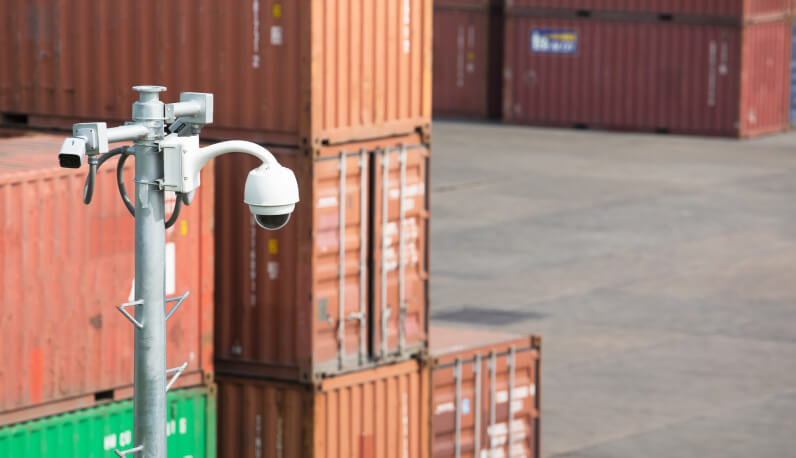
Where Warehouses Are Most Exposed
For most warehouses, the greatest exposure is outside the building. It usually comes down to two places, the trailer yard and the loading dock.
The trailer yard comes first. A loaded trailer parked overnight is valuable cargo sitting in the open, and in some cases the entire trailer disappears instead of just the goods inside. It is also the hardest part of the property to light well and keep under constant watch. Add trucks coming and going through the day, along with visitors, contractors, and deliveries, and it becomes difficult to spot activity that genuinely does not belong.
The loading dock is the second weak point. Warehouses are designed to move freight quickly, not to slow people down. Overhead doors open and close all day, personnel doors sit beside them, and gates control the flow of trucks rather than people on foot. Between shifts, it takes only one dock door left unsecured, or one side door that did not latch properly, to create an easy way in.
Anyone who manages a warehouse already knows these are the busiest parts of the property. What surprises us is how often the security ends up focused somewhere else, usually around the office entrance instead of the dock, the yard, and the perimeter where most after-hours problems begin.
Warehouse operations also rarely stop at exactly the same time every day. Late deliveries, overnight shipments, maintenance crews, and early-morning loading all create legitimate activity outside normal business hours. A good security system has to tell the difference between expected movement and activity that deserves attention, without generating so many nuisance alerts that people start to ignore them.
Getting the Cameras Right
Cameras carry a lot of the load on a warehouse, but only when they are built around the property instead of the front door.
Coverage is the first thing we check. It is common to find good cameras on the office and the main dock, while the trailer yard, the back fence, and the staging area barely register. Those blind spots are where the losses happen.
We also look at how people actually move around the site, instead of treating every camera as a separate view. Someone can enter through the perimeter, cross the trailer yard, and reach the loading dock in under a minute. Good camera placement follows that path, with overlapping views that let operators and investigators follow an incident from start to finish instead of piecing together disconnected clips.
Light is the second thing we check. A camera looking over a dark yard gives you very little at the hour you need it most. On most properties, improving the lighting, the camera angles, and the overlap between views does more for security than replacing every camera with a higher-resolution model.
Another thing we look for is whether the cameras are positioned to identify people, not simply to prove someone was there. Seeing movement is useful. Being able to recognize a face, a vehicle, or a trailer number is what makes the footage valuable afterward.
Cameras that only record, though, tell you what happened after the fact. On a warehouse that is often not enough, which is where the next layer becomes valuable.
Live Video Monitoring for the Yard
Recording is one thing. Having someone respond is another.
With live video monitoring, a monitoring center can look in on the yard after hours and step in the moment a person crosses the fence or moves between the trailers. Many setups add a speaker on site, so an operator can call the person out directly, which sends most of them off before anything is taken.
It is also one of the few security measures that changes what an intruder experiences. Instead of assuming nobody knows they are there, they hear a live voice naming their location and letting them know they are being watched. In many cases that alone is enough to end the incident before it becomes a theft or a break-in.
Warehouses are one of the few commercial properties where live video monitoring often delivers a stronger return than simply adding more cameras, because the challenge is usually responding quickly rather than collecting more footage.
For a wide-open yard that no guard is walking at three in the morning, this is usually the piece that does the most good. It turns the cameras from a record you review later into something that can interrupt a theft while it is still happening.
Alarm Monitoring After Hours
Cameras and live video monitoring protect the outside of the property. Inside, the monitored alarm still does the work it has always done, and it matters most when the building is empty.
A warehouse needs an alarm built for a large open space, with detection planned around the warehouse floor and the perimeter doors instead of relying only on a contact at the front entrance. The goal is to catch someone early, understand where they came in, and get that information to the monitoring center as fast as possible.
Warehouses are large enough that knowing which part of the building triggered first can change how responders approach the incident. Proper zoning helps operators understand whether someone entered through a dock, a personnel door, or another part of the building.
Just as important is how the alarm reports. A warehouse should not depend on a single communication path. Dual-path reporting, using both internet and cellular connections, keeps alarm signals moving even if one path fails. On a building that can sit empty for twelve hours or more, that reliability is every bit as important as the sensors themselves.
This is the side of the business we spend most of our time on. When the alarm is video-verified, a confirmed person on camera carries far more weight than an unconfirmed signal on its own. It also ties the monitored alarm, the cameras, and live video monitoring into one coordinated response instead of three separate systems working on their own.
The Inside Problem: Shrinkage and Who Has Access
Not every warehouse loss starts with someone climbing a fence. A steady share comes from inside the operation itself, inventory leaving a little at a time with people who already have legitimate access. It rarely looks like a break-in, which is why it can go on for weeks or months before anyone notices a pattern.
Access control helps narrow that window. Readers on loading docks, stockrooms, equipment rooms, and other high-value areas make sure only the right people can enter, and every door event is recorded automatically. When inventory counts stop matching the paperwork, you have a record of who entered an area and when, instead of trying to rebuild the day from memory or camera footage alone.
The other benefit is accountability. Access can follow the job rather than the person. Warehouse staff, supervisors, maintenance contractors, and delivery drivers rarely need the same level of access, and separating those permissions cuts down unnecessary movement through sensitive parts of the building. It also makes onboarding and offboarding much simpler as teams change. This becomes especially important during seasonal peaks, when temporary staff and contractors may need access for only a few days or weeks.
The habit that undoes all of it is convenience. We still find dock doors left unlocked for an entire shift because it makes loading easier, and then nobody remembers to lock them again when the crew changes over. Access control works best when it supports clear operating procedures instead of standing in for them.
A mistake we run into constantly:
What We Look At During a Warehouse Security Walkthrough
- The yard: whether it is well lit and covered all the way to the perimeter, or the cameras stop at the loading dock
- The loading docks: whether the dock doors, personnel doors, and trailer bays are covered, and whether there is a clear process for securing them between shifts
- The perimeter: whether the fences and gates are simply barriers, or there is detection if someone climbs, cuts, or enters after hours
- High-value inventory: whether expensive stock is stored separately with controlled access, or every employee can reach it
- The alarm system: whether it is professionally monitored and video-verified, or every after-hours alarm looks the same
- Access records: whether you can quickly see who entered an area and when if something disappears tomorrow morning
- Loading patterns: whether trailers regularly block camera views or create blind spots that did not exist when the system was installed
Securing a Warehouse or Distribution Center in Dallas and Fort Worth?
Warehouses carry different risks from offices, retail stores, or clinics, and they deserve a security system built around how freight actually moves through the property. Dallas Alarm Systems designs and supports integrated warehouse security across Dallas, Fort Worth, and the surrounding metro, combining monitored alarms, security cameras, live video monitoring, and access control into one coordinated system. If you would like a second opinion on your current setup, we will walk the property with you and show you where the biggest risks are before recommending a single piece of equipment. See the areas we cover,


